Tuesday, March 26, 2013

For God and Country

President Obama and his national security team watch the live feed from
the Bin Laden raid on May 2nd, 2011.
     Sohaib Athar heard the sounds of helicopters overhead and decided to start tweeting about it. It was a little after 1 a.m. on Monday, May 2nd 2011. Athar tweeted "Helicopter hovering above Abbottabad at 1AM (is a rare event)." Unknown to Athar at the time, he was tweeting the results of the largest manhunt in history.
     The search for Osama Bin Laden began even before the September 11th, 2001 terrorist attacks. He was placed on the FBI's "ten most wanted fugitives" and the "most wanted terrorist" list for his role in the 1998 US embassy bombings in East Africa that killed over 223 people. By this time, the US intelligence community knew his name and were aware of Al-Qaeda as a new hostile force to be reckoned with. After September 11th, 2001, Osama Bin Laden became the most wanted man in history and for the next ten years, the United States led the effort to bring him down.
     The cleanup at Ground Zero had barely begun in December, 2001 when the US launched an assault into the Tora Bora cave complexes in the White Mountains of Afghanistan where it was suspected that Al-Qaeda and Bin Laden himself was holed up. Using a joint force of US, British, German and Northern Alliance troops, the attack into Tora Bora lasted until December 17th, 2001. After a thorough search of the Tora Bora area in January, no sign of Bin Laden or any senior Al-Qaeda personnel could be found. It was assumed he must have slipped into Pakistan during a brief truce in the fighting.
     What followed was a frustrating six years of dead ends, false leads and misinformation concerning Bin Laden's true location. Some believed he was dead, others claimed to have seen him in various locations around the world in a variety of disguises. The news media turned the hunt for Bin Laden into a farcical  "Where's Waldo" that no one took seriously. However, this did not phase a key group of dedicated analyst and agents within the Central Intelligence Agency who relentlessly burned the midnight oil and chased every lead no matter how remote. What was known about Bin Laden was that he used couriers for communication with other Al-Qaeda operatives to avoid detection and that he never, ever used telephones and email. After a Herculean effort, a breakthrough occurred in 2007 when the real name of one of Bin Laden's couriers was learned. It would be another two years before it was discovered that the courier, Ibrahim Saeed Ahmed known as Abu-Ahmed al-Kuwaiti, was living in Abbottabad, Pakistan in a custom built compound located at the end of a dirt road less than a mile from the Pakistani Military Academy. Satellite photos of this area prior to 2005 showed an empty field, so the structure was new to the neighborhood and featured some very unique features. For one thing, the entire compound was surrounded by a 12 to 18 foot high concrete wall topped by barbed wire. The main three story building had an additional 7 foot high privacy wall on the balcony so that whomever was on the other side could walk around and not be seen. This type of building was extremely unusual for the area and immediately aroused suspicion within the CIA that this building was meant to hide someone of great importance.
     Immediately, the place was put under surveillance and it was further learned that the residents of the compound burned their trash rather than putting it out to be collected and the house had no phone or Internet connection. Still, analysts at the CIA could not definitively say that it was Bin Laden himself who lived there. Some felt that it was probably a well to do drug dealer rather than the world's most wanted terrorist. Through the use of high resolution satellites and an RQ-170 Sentinel drone, the National Geospatial-Intelligence Agency was able to create a three dimensional  rendering of the house as well as identifying the number, height and gender of the residents of the compound. The circumstantial evidence was then put through a process known as "red-teaming" in which all the information is reviewed independently and it was concluded that no other candidate fit the profile as well as Bin Laden did. It simply had to be him.
     At this point, the mission to capture or kill Osama Bin Laden became "Operation Neptune Spear". It was decided to use a group of Navy SEALS from the ultra elite Navel Special Warfare Development Group (DEVGRU) sometimes erroneously referred to as Seal Team Six in the media. Red Squadron from DEVGRU was on their way home from a deployment in Afghanistan at the time, so they were chosen to be the go-team as they could be redirected without raising too much attention. Operational security was of the utmost importance here, no one wanted to tip off Al-Qaeda that their boss had been found and targeted. A mock-up of the Bin Laden compound was built in a remote area of North Carolina and the assault team from Red Squadron practiced daily without being told who the target actually was. Special top secret stealth UH-60 Blackhawk helicopters were used for the raid due to the minimal radar signature.The stealth helicopters had been developed in total secrecy and featured a special radar reflective paint and extra rotor blades to aid in reducing any sound signatures. Pakistan had not been informed about the impending operation for security concerns, so stealth was all important. The idea was to insert quickly and quietly and be on the way back across the border before anyone knew what happened. 
     In addition to the assault team, a quick reaction force (QRF) was to be positioned nearby in heavy lift Chinook CH-47 helicopters in case the team had to "fight their way out". At last, everything was ready. There was no moon at this time in Pakistan, so the conditions were perfect for a nighttime raid. On April 29th, 2011 President Obama gave the final go-ahead for the raid the following night, however cloudy weather prevented the mision from going off as planed so it was decided to go on May 1st. At 3 p.m. that afternoon, the president and his staff moved into the White House Situation Room to watch the raid happen live on night vision feed from a Sentinel drone flying overhead. On board both stealth helicopters piloted by members of the elite 160th Special Operations Aviation Regiment, the two dozen men from Red Squadron sat in silence. As they approached the designated landing zone, one of the helicopters experienced a sudden and violent condition known as a "vortex ring state" caused by high air temperature and a loss of lift due to the compound's high wall. The aircraft bucked violently with the tail end clipping the top of the wall and the machine started to tilt. The pilot knew exactly what had happened and expertly drove the nose of the aircraft into the ground which prevented the craft from pitching onto it's side which would have been disastrous to the passengers. With one helicopter down, the remaining Blackhawk set down as planed and the SEALs made their way to the compound wall in total silence using only their night vision devices. In order to force their way into the compound, the assault team relied on breaching charges to blow the metal security doors. The concussive booms from these explosives going off startled nearby neighbors who began move outside their homes to see what was going on in the neighborhood.
     Moving just outside the main house, one of the two assault teams took fire from an AK-47 belonging to the courier al-Kuwaiti. He was killed by several rounds of 5.56 fired from the assault team's sound-suppressed HK 416 carbines. Kuwaiti's wife was hit in the shoulder but did not die. Next, the team encountered al-Kuwaiti's brother Abrar in a room downstairs. He was shot and killed as was his wife, Bushra. Moving up the stairs, Bin Laden's son rushed the second assault team and was also shot and killed. Moving up the stairs to the third floor, one of the SEALs saw Bin Laden peer over the third floor ledge, then dart into a room. According to a team member, Bin Laden then glanced out into the darkened hallway and was immediately shot in the head by a team member and fell back into the room. The team member then entered the bedroom and saw two of Bin Laden's wives standing over his body on the floor. One of them started to scream at him in Arabic and looked like she was about to charge, so the SEAL tackled both women and forced them out of the way. A second team member burst into the room and shot Bin Laden twice more in the chest. The worlds most wanted terrorist and mastermind of Al-Qaeda,  died on his bedroom floor in the company of two American commandos. A quick visual inspection of Bin Laden revealed that the first shot was the one that most likely killed him.
  The high velocity 5.56 round entered his forehead and had blown out part of his skull so that his face was distorted. Brain matter was spilling out from the gaping hole and his face was covered in blood. Several digital photos were taken and then one of the Seal team members went out onto the balcony where a number of children that were found in the compound were placed. He asked one of the older girls who the dead man lying on the floor was and she replied "Osama Bin Laden". He then went to one of Bin Laden's wives back in the room and asked her the same thing. At first she didn't respond, so he grabbed her roughly by the arm and said, "Stop fucking with me now, who is that in the bedroom?" "Osama" the woman replied. They had confirmation from two sources at the location.  The SEAL team leader then radioed "For God and country, I pass Geronimo, Geronimo E.K.I.A." (enemy killed in action). This was a predetermined confirmation that Bin Laden was dead. The confirmation was sent live to the White House Situation Room where President Obama said "We got him".
     A body bag was brought along on the raid and the team members worked quickly to put Bin Laden's corpse inside and zip it up tight. A quick search of the compound netted numerous computer hard-drives, thumb-drives, disks, cell phones and paper memos. All in all, they hit the jackpot for Al-Qaeda intelligence.  All of this material was stuffed into several duffel bags to be brought back to the base at Bagram Airfield in Afghanistan for analysis. As the two assault teams prepped to leave, one of the team members rigged the downed stealth helicopter with explosives to destroy it in place so that nothing could be gleaned from the top secret craft. As they were now down a helicopter, one of the nearby Chinooks was brought in to ferry the assault team back to base. In all, the raid to kill Bin Laden had taken less than 40 minutes from the time the first pair of boots hit the ground to when they were airborne once again. However, it took over 10 years, close to a billion dollars and numerous lives to even get to that point.
     I remember on the day that it was announced that we had finally gotten Bin Laden, I awoke early that morning and headed downstairs for a drink of water. It was my wife's birthday the next day and for some reason I just happened to glance at the news on my mobile phone. I went upstairs and climbed back into bed and told my wife the momentous news that we had killed Bin Laden. She said simply, "Best birthday present ever!"

Thursday, February 21, 2013

My Boy Jack


     18 year old Second Lieut. John Kipling was weeping as he staggered through the mud. He lost his glasses and the pain from the bullet wound in his jaw was excruciating. How he wished he was back home instead of the stinking, filthy charnel house that was the Loos Battlefield. It was September 27th, 1915 and Kipling's regiment, the famed Irish Guards had taken a pounding while advancing on the German held positions near Hill 70. In reality, John (Jack) Kipling should not have even been here. His eyesight was so poor he was initially rejected from military service but was given a commission with the Irish Guards thanks to the influence of his father, famed author Rudyard Kipling.
     Jack had just turned 18 when he was posted to France. Within six weeks, 13 British divisions, including the Irish Guards, would be in action in what was to become the Battle of Loos. Initially, the huge number of both French and British soldiers gave them a brief advantage that allowed for the capture of the town of Loos. However due to communication and supply problems, the breakout could not be exploited and the delay gave the Germans time to reinforce their positions. This proved disastrous for the allies the next day as they attempted to take the fortified German lines. In four hours of fighting, there were over 8,000 casualties out of a total force of 10,000 men.
     Initially, Jack was listing as missing after the battle as were so many thousands of young men. The notion of being missing in combat can have several meanings. One can be unaccounted for, but completely safe in a different sector or, as is often the case, there can be no identifiable remains whatsoever. The body can be blown to atoms by high explosive shells in an instant or buried under tons of mud and earth. All anyone knew that 2nd Lt Kipling was missing from the battle. Rudyard and his wife, Caroline, were completely grief stricken. Using every possible channel and high level contact, they tried desperately to get any news of the whereabouts of their son, but as the weeks stretched into months and then years, it became apparent that Jack was dead and his remains had been lost. Shortly after he was declared missing in 1915, Rudyard Kipling wrote this poem for his son:

"Have you news of my boy Jack?"
Not this tide.
"When d'you think that he'll come back?"
Not with this wind blowing, and this tide.
"Has any one else had word of him?"
Not this tide.
For what is sunk will hardly swim,
Not with this wind blowing, and this tide.
"Oh, dear, what comfort can I find?"
None this tide,
Nor any tide,
Except he did not shame his kind -
Not even with that wind blowing, and that tide.
Then hold your head up all the more,
This tide,
And every tide;
Because he was the son you bore,
And gave to that wind blowing and that tide.

     In 1992, the Commonwealth War Graves Commission announced that a grave of an unknown Irish Guards Lieutenant located in the St. Mary's Advance Dressing Station Cemetery in Pas de Calais had been identified as that of Jack Kipling. However, that claim is in dispute for several reasons. The body that was found had rank pips belonging to a 1st Lt and Kipling at the time of his death was only a 2nd LT. Also, the location of where the body of the 1st LT was found was misidentified as well. The curator of the Irish Guards museum even stated that the body in the grave is most assuredly not Jack Kipling. So today, 2nd Lt. John Kipling has two memorials. One is the headstone in St Mary's Cemetery and the other is on the Memorial to the Missing at Loos that list over 20,000 men who have no known grave.

Wednesday, February 20, 2013

Shot at Dawn

     Called “shell-shock” during the Great War, today it’s known as Post Traumatic Stress Disorder and it is a legitimate battlefield injury. Today having PTSD can give you access to medical care as well as disability benefits with the government. During the Great War, it could get you shot at dawn for cowardice.

     Between 1914 and 1918,  306 British soldiers were executed by firing squad for such offenses as desertion, cowardice, striking an officer, throwing away arms and falling asleep on duty. Those who were sentenced to death were denied legal representation and the right of appeal and were shot very soon after their court martial ended. In many cases, the men were not even examined by a physician before the hearing. The average length of a court martial hearing was about twenty minutes. Usually, the condemned was led back to his cell and shot by a firing party at dawn the next day.

     On the morning of the execution, the condemned soldier was led out of his cell or holding facility, having spent the night with the company of a regimental chaplain. He was then brought to the place of execution and tied to a single post. A small section of white cloth was pinned to the soldier’s chest over where his heart would be. This would give the firing party something to aim at and would, in theory, result in instantaneous death. If not, the commanding officer was obliged to shoot the wounded solider in the head with his pistol. The firing party was made up of six soldiers usually, and one would surreptitiously be issued with a blank round so that no one soldier could be 100% certain that he fired the fatal shot.

     One of the first soldiers to be executed was Private Thomas Highgate who fled from the Battle of Mons, unable to bear the carnage. He was found hiding in a barn and was immediately court-martialled and found guilty despite the fact that he was undefended as all of his comrades to a man had been killed in the slaughter at Mons. A senior officer insisted that Highgate be shot “At once, as publicly as possible”. Highgate was informed of his fate, and was shot 43 minutes later. He was 19 years old.

     Another tragic case was that of Herbert Burden, who at age 16, lied about his age to enlist into the Northumberland Fusiliers. Ten months later, he was court-martialled for fleeing the battlefield after seeing his comrades slaughtered during the fight for Bellewaard Ridge in 1915. At the time of his execution, Herbert was only 17 years old, not even legally old enough to be in his regiment. He was nothing more than a terrified teenage boy.

     To the British high command, these executions were necessary in order to make an example out of the condemned to ward off further desertions or other acts of cowardice. The fact that a large number of these men were no doubt suffering from post traumatic stress disorder did little to prevent their fate. In those rare cases when they were actually examined by a doctor, many of the attending physicians were predisposed by their own prejudices to find the accused of sound mind so that they might be executed.

     Nearly a century has passed and we look back on those dark days through 21st century sensibilities. Today, executing a traumatized solider would be completely unthinkable as would the notion of forcing men to march slowly into machine gun fire. Perhaps if the British high command had paid for their criminal stupidity in these matters by they themselves being shot at dawn, the war would have been conducted very differently.

     In June 2001, a memorial to those 306 souls who were executed was unveiled at the National Memorial Arboretum in Staffordshire. Mrs Gertrude Harris, the daughter of one of the 306 soldiers executed, did the unveiling of the memorial which features 306 posts that list the names of all the soldiers who were shot at dawn.

Wednesday, January 30, 2013

What Remains


The Somme battlefield 97 years on

     "How did they fight the battle with all these monuments in the way?" was an actual question that was asked at the Gettysburg National Military Park. It was gently explained that the monuments in question were in fact erected after the fighting had ceased. To many, a visit to an actual battlefield can be many things depending on one's level of interest. It can be somber and reflective, intriguing, morbid or it can be confusing. With Gettysburg, it became a tourist attraction quite literally when there were still dead soldiers carpeting the fields. Throughout the long years, as Gettysburg became a national park, the landscape changed somewhat but not dramatically. Today, there is a policy within the National Park Service to return the battlefield exactly to it's appearance as it was in July of 1863. To this end, orchards have been replanted, large areas have been clear-cut of trees and much vegetation has been cleared away. The effect has been a dramatic vision of the battlefield as the soldiers of 1863 saw it. The exception here being the paved roads and monuments, of course.
     For the battlefields of the 20th century, in particular WW1 and WW2, change in the landscape can either be dramatic or nonexistent depending on where one is. In the area around the French town of Verdun which was the scene of brutal fighting in 1916 there are still areas today known as "Zone rouge" (red zone) due to catastrophic damage to the environment which has rendered the land uninhabitable and unusable for farming and forestry due to the soil being poisoned by human remains, gas and unexploded munitions. Two of the main forts near Verdun, Ft. Vaux and Ft. Douaumont have been preserved as they were as well as the surrounding land. Although green grass now grows where only a sea of mud once existed, one can still clearly see the pockmarks of shell holes and shallow trenches. In the red zones, unexploded shells, human bones and rusted equipment litter the surface of the ground and are clearly visible even today.
     Much of the Western Front today has been erased from the land due to farming and expansion. Many of the battlefields were farmland back then and are still farms today. Farmers still regularly plow up shells, grenades and other deadly relics from the intense fighting that once raged over their land. It is estimated that one in four shells from WW1 never detonated and lie sleeping in the soil. To this end, the French Department of Mine Clearance recovers and destroys about 900 tons of rusted ordinance each year and it is estimated that this work will continue for the next twenty five years or so such is the staggering number of shells that were fired during the Great War.
     Many of the battlefields of the Second World War are in a similar state. With housing and industry expanding at an exponential rate, it's almost impossible to find what would be considered a "pristine" battlefield in this day and age. The exception here would be certain islands in the Pacific, such as Peleliu, which up until recently were largely untouched since the fighting ended. As little as ten years ago, one could still walk the trails and find rusted helmets, canteens and human remains in the numerous caves. Today, thanks to relic hunters and looters, this is no longer the case. Over on what was once the Eastern Front, many of the more obscure battlefields remain largely untouched in remote areas in Estonia and Latvia. Recently, some remarkable relics in pristine condition have been found in the numerous peat bogs that dot the area. Tanks, weapons, equipment and even human remains were found in incredible states of preservation due to the natural preservatives of the bogs.
      Despite all this, one constant remains. The land itself changes over time. The war torn landscape heals itself bit by bit. Shell holes and trenches fill in, barbed wire rusts away to dust, concrete bunkers crumble away and trees sprout up and grow thick over what was once barren and shell torn land. With very few exceptions, it's now all but impossible to stand on a battlefield and get a clear vision of what the area once looked like. Perhaps it's really for the best that way.

Tuesday, December 4, 2012

The Worst Place on Earth

When speaking of the Holocaust in Europe, one tends to think of such monstrosities as Auschwitz, Chelmno, Treblinka and others. Today the names of these appalling places are burned into our collective minds and rightly so. However few have heard of the concentration/extermination camps that existed in Yugoslavia. One in particular, Jasenovac, was the epitome of savage barbarity and cruelty so extreme it’s hard to fathom in this day and age.

Built in August of 1941 by the fascist Ustase regime, Jasenovac became an extermination camp for ethnic Serbs, Jews and Roma. The camp actually consisted of five subcamps spread out over eighty one square miles on both banks of the Sava and Una rivers in what is now the Independent State of Croatia. The actual extermination grounds were located in the village of Donja Gradina.

The exact numbers of people killed is still unknown to this day. The US Holocaust Museum in Washington D.C. estimates that between 77,000 and 100,000 people were murdered in the three and a half years the camp was in operation. Some scholars believe that number is actually closer to 700,000.

In April of 1941, the independent state of Croatia was founded and supported by Nazi Germany and fascist Italy. Croatia adopted similar racial and political policies that the Nazis followed in that their goal was the complete destruction of Jews and Roma, but the main goal of the Ustase regime was the total annihilation of the Serb people.

The conditions for the inmates were perhaps worse at Jasenovac than at other similar camps. There was no potable water so the prisoners were forced to drink from the Sava River. The barracks were filled with decomposing corpses and unimaginable filth which quickly spread diseases like typhus, dysentery and diphtheria.

The Ustase were particularly adept at generating fear and anxiety through extreme acts of cruelty in which the prisoners were forced to witness. Often, they would be kept standing for hours while a small number were selected at random to be tortured and killed in full view. Many times just for sport, the guards would drown prisoners in the open air latrines by either tossing the weakest ones in, or by physically holding them under.
The guards would often make bets with each other as to how many inmates they could slaughter. One guard, Petar Brizica, used a special curved knife blade normally used for cutting wheat to slash the throats of over 1300 newly arrived prisoners.

The Ustase would also cremate prisoners alive who were still conscious and awake. Others were killed by hammers, saws and blunt instruments and others still would be disemboweled and thrown into the river while still alive. All of this being done with the implicit approval of the Nazi overlords. The Ustase even ran a camp for Jewish, Serbian and Roma children. The Sisak children’s concentration camp housed over 6,000 children aged 3 to 16 in deplorable conditions. Over 4,000 of them perished often at the barbaric hands of the guards who took special delight in killing the tiny helpless victims.

The end of Jasenovac came in April of 1945 as Yugoslavian partisans started to approach the camp. The Ustase attempted to speed up the killings which resulted in a camp revolt on April 22nd.  Over 600 prisoners revolted and 520 were killed with only 80 escaping into the surrounding woods. The Ustase then killed the remaining prisoners and set fire to the camps leaving nothing but ash and bones behind.
After the war, Yugoslavian president Josip Tito sought to erase the memory of the Ustase crimes as a way of uniting his countrymen and this policy continued into recent times. The Jasenovac Memorial Site was officially opened to the public on July 4th, 1966 and continues to be reinterpreted to this very day. Most of the physical evidence of the camp has been lost, much of it by the Ustase as they attempted to hide all evidence of their crime. Only depressions in the ground and the occasional foundation can be seen today alongside memorials such as the massive Stone Flower, offer any tangible evidence of the massive and sadistic crime that was committed.

Thursday, July 26, 2012

The Mines of Messines

     Captain Oliver Woodward wiped the sweat from his eyes and carefully placed the stethoscope to the clay wall in the gallery. Nothing.........the German sappers were still unaware that beneath their feet lay close to 70,000 pounds of ammonal explosive. Mining under ones enemy was not a new concept and had been a method used in siege warfare since ancient times. Now on the Western Front, it was about to enjoy a brief and violent resurgence in what was to be known as the Battle of Messines.
     With a trench system stretching from the Swiss border to the North Sea, the Western Front was a static battlefield that quickly degenerated into a bloody war of attrition. Ground taken by either side could be measured in yards, not miles. The allies were desperate to break the German lines while avoiding a catastrophic loss of life like they had experiences during the Battle of the Somme in July of 1916. To this end, it was decided to dig a series of mines under the German trenches, pack them with tons of explosives, then right before the assault, detonate the mine which would create a massive crater which could then be occupied and reinforced. This was tried on July 1st, 1916 when the Hawthorne Ridge mine was detonated under a German redoubt near the village of Beaumont Hamel. Unfortunately, the mine was blown ten minutes too early before the main assault was to begin, so the Germans had enough time to occupy part of the massive crater and the assault failed.
     The British, not wishing a repeat of that disaster decided to dig a series of 21 mines under the German lines in the Ypres Salient. A special unit made up of Australian miners, the 1st Australian Tunnelling Company, were brought into the area to dig the mines. Largely made up of veteran miners, the Australians began to dig their way under the German lines starting in September of 1916. Working in depths of over 125 feet deep, the miners used a technique known as "clay-kicking", which was a laborious process in which the miner inserts a special tool with a cup-like end into the soil and then withdraws a sizable chunk which is then placed in a sandbag and handed off to the next man. The advantage to clay-kicking, although labor intensive, it's virtually silent which was a huge consideration when digging under the German lines. Often if a mine was discovered, the Germans would try to counter the mining operations by using a technique called "camouflets", which were small explosive charges designed to collapse the mine tunnels of the allies. On several occasions, desperate hand to hand fighting erupted in the underground galleries between the Australian and Germans.
     Overall, the British had the advantage when it came to digging mines due to their experience and techniques. The could dig quickly and silently, which is something the Germans apparently could not do. By the time of the Battle of Messines on June 7th, 1917, the 22 mines were ready. As was the plan, an artillery barrage began six days earlier and continued up until 2:50 a.m. on June 7th. Two parachute flares were then fired, and the German defenders rushed back to their forward positions thinking an infantry assault was eminent. At 3:10 a.m., 19 mines were simultaneously detonated in what at the time was the greatest man-made explosion in history. The blast lit up the night sky around the Messines Ridge in what was described as a "pillar of fire". Over ten thousand German soldiers were obliterated in the explosion that could be heard and felt over 20 miles away. Some even claim the shockwave was felt as far away as London. The largest mine created a crater over 40 feet deep and over 250 feet in diameter. Surviving Germans soldiers were completely disoriented by the blast and many cried in pure terror at what they had just witnessed. Immediately after the detonations, the British artillery fire resumed in a creeping barrage that screened the advance of the infantry. By noon of that day, all the intended target of the assault had been reached and the majority of the Messiens Ridge was now in British hands. Overall, the attack into the Ypres Salient was a resounding success thanks to the tactics of using mines, artillery, tanks and infantry. As for the remaining three mines that did not go off, one was discovered by the Germans prior to the attack and dismantled, one detonated on June 17th, 1955 when lightening struck a steel pylon that had been erected over the location of the hidden mine and the one remaining mine has yet to go off although the authorities believe they have identified it's location. As for Captain Woodward, he survived the war and passed away quietly at the age of 80 in Hobart, Tasmania.

Wednesday, July 18, 2012

A Most Valiant Action

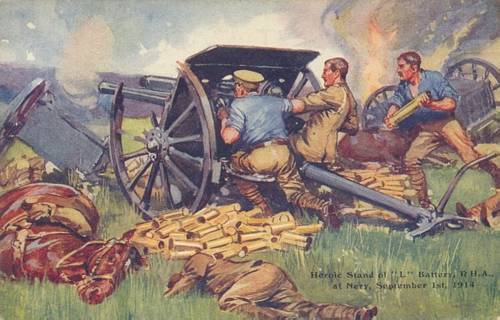
     It was a little after in the morning when 33 year old Captain Edward Bradbury roused the men of “L” Battery, Royal Horse Artillery from their slumber just outside the French village of Nery. It was September 1st, 1914 and the British and French troops were engaged in a long, fighting retreat to the River Marne on the Western Front. The German army, acting under the Schlieffen Plan, had plowed through the allied attempt to stop their push to Paris. In what was to become known as the Retreat from Mons, the British and French troops were engaged in a desperate fighting retreat to stop the marauding Germans from reaching the capital city. The conflict known as The Great War had begun on July 28th, 1914 with a declaration of war by Austria-Hungary against Serbia. Great Britain declared war on Germany on August 4th after Germany ignored a British ultimatum that Belgium be kept neutral. War had now come and the world would never be the same again.
     The men of “L” Battery were stood down to rest due to the fact a thick fog had enveloped the town of Nery and the surrounding countryside. Visibility was down to nothing, so the men were ordered to rest, prepare breakfast, and water their horses. At this time, horses were used to transport the quick firing thirteen pounder guns of the Royal Horse Artillery. Although the men were stood down, they kept the horses harnessed to the guns, but with the limbers lowered to ease their burden. At , a patrol from the British 11th Hussars encountered a large force of German cavalry just outside the village and raced back to alert the gun crews. About 20 minutes later, machine-gun and artillery fire began from the heights overlooking the village. The German 4th Cavalry Division had signaled it was surrounded by a “considerable hostile force” and were now trying to counter-attack what they thought was a large number of British cavalry. The German commander, realizing what was going on, ordered a dismounted attack on the village itself.

      Down in the village of Nery, the German gunfire caused panic amongst the horses of the cavalry and artillery, many of which bolted leaving the guns immobilized where they now stood.  The overall commander of “L” Battery was knocked unconscious by a shell blast and it was Captain Bradbury who now took command. He managed to get three guns into position to counter the twelve or so German guns up on the ridge. Two of the thirteen pounders were knocked out almost immediately, which just left the one remaining gun. That one remaining gun, under direction of Captain Bradbury, Sgt David Nelson and Sergeant-Major Thomas Dorrell kept up a steady fire, which drew the German artillery fire away from the British cavalry. Captain Bradbury was acting as an ammunition bearer when a shell fragment tore off one of his legs. Although bleeding to death, he continued to direct the gunfire until he died. Sgts Dorrell and Nelson continued to fire the gun until reinforcements arrived around As a result of the gunfire from the single thirteen pounder gun of “L” Battery, the British cavalry regiments were able to outflank the German cavalry which was attempting an attack on the village itself and were able to force them to retreat taking approximately seventy eight German prisoners. Three Victoria Crosses were awarded to “L” Battery that day, one going to Captain Edward Bradbury who was killed in the action, the other two going to Sergeant-Major George Dorrell and Sergeant David Nelson. Nelson was killed in April 1918 while Dorrell survived the war and would reach the rank of Lieutenant-Colonel. He served in the Home Guard during the Second World War and died at the age of 90 in 1971. The three Victoria Cross medals as well as the actual thirteen pounder gun used in the engagement, now called the “Nery Gun”, can be seen today at the Imperial War Museum in London. In an unusual honor, L Battery had the title of “Nery” added to their official name. They are now known as “L (Nery) Battery, RHA Tactical Group Battery”.


Wednesday, April 18, 2012

The Ghost of the Grand Banks


It was close to midnight on a moonless April night when lookout Frederick Fleet spotted the giant iceberg in the path of the great ship. The berg loomed out of the dark, calm sea like a phantom. He rang the bell in the crows-nest three times and then telephoned the bridge of the Royal Mail Ship Titanic where Sixth Officer James Moody was on duty.

“What do you see?” asked Moody into the handset

Fleet replied “Iceberg right ahead!”

Moody relayed the message to First Officer William Murdoch who ordered “Hard a’starboard!” and he also rang “Full Astern” on the ship’s engine order telegraphs. The process of setting the engines in reverse as well as physically turning the ships’s tiller took precious minutes as the berg loomed into view. It would have probably saved the great ship had Murdoch simply turned the wheel while maintaining the forward speed. The forward momentum with the change in direction would have caused the Titanic to miss the berg by several feet.

Sadly, this is not what happened. Instead, the ship hit the massive berg with a glancing blow to the starboard side. It is now thought that a large underwater spur of ice caused sections of the hull to buckle at the seams which caused a fatal amount of water to enter the ship. Scientist in recent years have put the blame on the iron rivets that were used to hold the plates together. It was discovered that the iron used in the rivets was an inferior quality and was in fact quite brittle. Continuous immersion in near freezing sea water did little to help this situation.

It was all over by 2:28 A.M. when the stern section of the RMS Titanic disappeared under the frigid North Atlantic. All told, one thousand five hundred and fourteen souls went to their deaths that dark April 15th night. Either drowning in the ice cold salt water or freezing to death as they bobbed on the surface.

One hundred years later to the day, the sinking of the RMS Titanic remains a maritime tragedy that continues to haunt and fascinate us to no end. Hundreds of books, films, and songs commemorate the appalling tragedy like no other. In terms of lives lost, the Titanic was nowhere near some of the later disasters that struck. In 1945, the MV Wilhelm Gustloff was sunk by a Soviet submarine with a loss of over nine thousand lives and more recently, the passenger ferry MV Dona Paz collided with an oil tanker and sank with the loss of over forty three hundred lives in 1987.

But it is the sinking of the Titanic that continues to haunt our collective imagination for a hundred years now. Many have pointed to the sinking as a metaphor for the end of the Edwardian era with its ferocious class distinction; in death all are equal. Multi-millionaire John Jacob Astor IV went to his death on the Titanic along with hundreds of second and third class passengers. At the time, Astor was the wealthiest passenger aboard.

Today, the wreck of the great ship lies on the sea bed of the Atlantic Ocean in a little over twelve thousand feet of water. Up until 1985, it was assumed the Titanic sank in one piece, however Robert Ballard discovered the wreckage had in fact split in two and was in much worse condition than anyone could have guessed. It has since been decided that the bow section of the ship broke off and plowed into the mud of the sea bed going about 40 MPH. The stern section continued to float for a short while before corkscrewing its way to the bottom. Much of the superstructure was sheared off during the decent which created a massive debris field around the wreckage. The bodies of the victims settled into the debris field as well and over time nothing remained except their leather tanned shoes, which have resisted decay and scavengers. Photos taken of a pair of shoes lying on the ocean floor are a mute witness to the human cost of the tragedy. Recent expeditions to the wreck of the Titanic have revealed that iron-eating bacteria are rapidly reducing the superstructure of the ship and it has been estimated that in less than fifty years time, the entire wreck will collapse as a pile of rust on the sea floor. Fortunately at the urging of Bob Ballard, UNESCO has declared the shipwreck a world heritage site that will protect the remains from future scavenging by souvenir hunters. Perhaps now at long last, the great ship can rest in the watery blackness that has been her grave for a hundred years.

Holocaust Remembrance Day


On April 19th, we observe Holocaust Remembrance Day in the US. The date comes from the Hebrew calendar and coincides to the 27th day of Nisan. It marks the anniversary of the Warsaw ghetto uprising which began on April 19th through May 16th 1943, which was the largest single revolt by the Jews during the Holocaust. In the end, the uprising was brutally crushed by the Nazis with some 13,000 Jews killed during the fighting and the remaining 50,000 residents captured and sent off to concentration and extermination camps, notably Treblinka.
In protest of the inaction of the western governments to intervene in the wholesale destruction of the Jewish people, Polish socialist politician and a Jew himself, Szmul Zygielbojm committed suicide in London to draw attention to the slaughter. His final statement was “I cannot continue to live and to be silent while the remnants of Polish Jewry, whose representative I am, are being murdered. My comrades in the Warsaw ghetto fell with arms in their hands in the last heroic battle. I was not permitted to fall like them, together with them, but I belong with them, to their mass grave. By my death, I wish to give expression to my most profound protest against the inaction in which the world watches and permits the destruction of the Jewish people”.
Last week, I was fortunate enough to be in attendance at a talk given by Holocaust survivor Israel Arbeiter, who painfully recalled his experiences at Auschwitz when he was in his early teens. Izzy, as he is known, was the sole survivor of a mass killing at the camp when an entire building full of people, 85 in all, were liquidated by the Nazis….he was number 86. He expressed his very sincere appreciation and thanks to the liberators of WW2, several of whom shared the stage with him.
Remembrance of the Holocaust began even when the fighting was still going on in Europe. As the camps were discovered, the allies began a careful and thorough documentation process, much of which was used as evidence in the Nuremburg Trials. The camps themselves, in many cases, were left standing as a permanent memorial to the largest crime in human history. Today, the remaining concentration and extermination camps are protected as UNESCO World Heritage Sites and stand as a stark contrast to those who would deny the Holocaust happened.
Aiding in the remembrance of the Holocaust is the testimony of the people who were at the camps and ghettos as well as the veterans who liberated these charnel-houses and saw for themselves what human beings are capable of. In one extreme case, US troops from the 157 Infantry Regiment of the 45th Division were so horrified and sickened by what they saw when they liberated Dachau that they rounded up and shot close to 50 German guards in a tearful rage. The young G.I.’s had never encountered anything like this before, but they would carry it with them for the rest of their lives. My late grandfather helped to liberate a sub-camp of Dachau and refused to speak of what he had witnessed there.
Ironically, it was the Nazis themselves that provided some of the best evidence of the Holocaust in the form of meticulous records. Today, these records are a chilling, but effective example of a planned genocide that targeted a specific group of people. It wasn’t some random crime of hate, but a very deliberate attempt to depopulate much of Europe’s Jewry.
At the end of his talk, Izzy Arbeiter uttered the statement that the Holocaust must “Never, ever be allowed to happen again!”, but sadly genocide continues in the 67 years since the end of the Second World War. During the 1970’s it was Pol Pot’s regime in Cambodia, in the 80’s it was El Salvadorian death squads killing thousands of innocent people, in the 90’s it was Rawanda and the Balkans and more recently it was Dafur. Granted, none of these events reached the level of the Holocaust of the 1940’s, but genocide still continues to be a tool of war in many parts of the world where stability is lacking and warlords are allowed to run amuck. Perhaps the greatest monument to the Holocaust we could ever build would be the complete elimination of genocide in any form. I would like to think that some day in the future we can look back upon these dark events and truthfully say “Never Again!”

Wednesday, March 28, 2012

Death in a high place


It was late June 2005, in the Hindu Kush mountain range that snaked between Afghanistan and Pakistan like a gossamer barrier. The border meant very little to the legions of hardened Taliban fighters who would routinely cross over into neighboring Pakistan to escape the Americans who were hunting them. These wild men of Afghanistan were seasoned mountain fighters used to moving quickly through impossible terrain and attacking en masse.
To Navy SEALs Mike Murphy, Danny Dietz, Marcus Luttrell and Matt Axelson it was a mission to be completed. The SEALs were part of a reconnaissance and surveillance team inserted just south of a mountain known as Sawtalo Sar and were tasked with observing, identifying and either killing or capturing Ahmad Shah, a local anti-coalition militia leader.
The SEAL team fast-roped from their MH-47 Chinook piloted by members of the elite US Army Special Operations Aviation Regiment and immediately set out for the summit of the mountain near the village where Shah was thought to be holed up in. It was dark and freezing cold by the time the men arrived at their overwatch position high up on the Sawtalo Sar. The real problem was a lack of vegetation or indeed finding anything larger than a pebble to hide behind, but the resourceful SEALs made due. They stayed in their area until mid-morning when the blazing sun half-baked the men alive in their exposed position. It was around this time that the SEAL team had an unexpected visitor in the form of three local shepherds and their flock of sheep. The SEALs forced the three Afghans to sit down while they debated what to do with them. According to survivor Marcus Luttrell, the team discussed possibly killing the unarmed shepherds to avoid compromise, but no one was comfortable with that idea. In the end, they simply let the three men go and almost immediately regretted it when not more than 30 minutes later, they were under attack by a group of 20-30 enraged Talibans armed with AK-47s and rocket propelled grenades. The battle lasted for several hours in a heroic feat of arms that should go down in history alongside Rorke’s Drift and the Lost Battalion. Slowly, the SEALs began to loose the gun battle and take serious injuries. Although the SEALs are trained and schooled to be the best war-fighters on earth, they are not bullet proof and they can only carry so much ammunition per man. The SEALs made several attempts to contact their combat operations center, eventually getting through by using an iridium satellite phone. Despite the calls for help, the only one left alive was Marcus Luttrell, who was discovered by a friendly Pashtun who gave him shelter in his village.
It was around this time that an even bigger tragedy involving the special operations fighters was happening. Knowing that a SEAL team was in peril, a massive rescue operation was under way. A quick reaction force was launched consisting of several helicopters filled with operators from various SEAL teams as well as SOAR personnel.
As the rescue force closed in, one of Shah’s fighters scored a direct hit with an RPG below the rear rotor of one of the MH-47’s. The rocket propelled grenade took out the transmission and rotor which caused the big aircraft to plummet to the ground like a stone killing all aboard. The loss of the three SEALs, combined with the eight on board the ill-fated helicopter as well as eight Special Operations Aviators was at the time the greatest loss of life in the special warfare community to date.
To the Taliban on the ground, it was a great victory. They looted the wreckage and the dead soldiers for weapons and equipment and even found a laptop with sensitive information on it. All in all, it was a disaster and a stunning blow for the Special Operations Command. In keeping with their creed “No man left behind”, the bodies of the sixteen operators as well as the three SEALs were recovered. Ahmad Shah and his cell of fighters returned to the area of the ambush three weeks later and continued to be a hostile presence in the area until he was killed in a gun battle with Pakistani police in April 2008. For survivor Marcus Luttrell, he owes his life to the friendly Pashtun named Gulab Khan and the other villagers who gave him sanctuary and refused to hand him over to the Taliban. Luttrell, through Gulab, was able to contact a Marine commander based in Asadabad who was finally able to extract him despite the fact that Luttrell had been moved several times to avoid capture. For his efforts in aiding an American, Gulab was threatened with death by the Taliban and was forced to relocate to Asadabad, near the American base. On September 14th, 2006, SEAL Team members, Matthew Axelson and Danny Dietz were posthumously awarded the Navy Cross for “undaunted courage and heroism” Marcus Luttrell was awarded the Navy Cross in a ceremony at the White House and in 2007, Lt. Michael Murphy was posthumously awarded the Medal of Honor for his actions during the battle on the Sawtelo Sar.

Thursday, March 22, 2012

The Witch of November


Captain Ernest McSorley tugged at the collar of his coat and squinted at the fading sun of the cold November afternoon. A veteran mariner, McSorley had over 40 years on the Great Lakes and high seas and was looking forward to retiring at the end of the shipping season to be with his ill wife. He had been captain of the Great Lakes freighter SS Edmund Fitzgerald for three years now and had a seasoned crew of 28 men under his command.
The big ore boat was somewhat of a legend due to her impressive size (729 feet long) as well as her record-breaking performance when it came to ore hauling. One of her former captains, Peter Pulcer, was known to play music and entertain tourists with a running commentary about the “Mighty Fitz” when navigating the Soo Locks on Lake Superior. Generally speaking, freshwater boats were built to last more than 50 years, so having been launched in 1957; the Edmund Fitzgerald was little more than halfway through her service life.
The weather reports for November 9th, 1975 were fairly typical for the Great Lakes but did show a storm system moving south of Lake Superior for the next 24 hours. Lake Superior is the largest fresh water lake in the world with a surface area the size of South Carolina. If it were possible to pump it dry, you could cover the entire land-mass of North and South American with over a foot of water. Its average depth is just over 480 feet although it plunges to over 1,300 feet in certain areas. Suffice to say, it’s a massive fresh water lake that acts as a mini-ocean and has produced some truly horrifying storms.
When the Fitz left Superior, Wisconsin that afternoon, she was carrying her usual load of taconite iron ore pellets that would be melted down into steel in one of the massive smelters near Detroit. She joined a second freighter, the SS Arthur Anderson under command of Captain Jesse Cooper, when both ships got word that a gale warning had been issued for the whole of Lake Superior.
Autumn is a tough season to be a mariner on the Great Lakes due to the high winds that blow across the water during the fall. Often the low pressure systems that fuel these winds pulls artic air from the north and warm Gulf air from the south to form storm systems that wreck havoc on shipping. These storms have the power of a Category 2 hurricane and are responsible for over 350 shipwrecks in Lake Superior alone.
When both the Anderson and the Fitzgerald got word about the “Witch of November” that was forming, both captains altered their course northward to seek shelter near the Canadian side of the lake. At 1 a.m. on November 10th, both the Arthur Anderson and the Edmund Fitzgerald were in the middle of a huge winter storm. As the center of the storm passed over the ships, the wind direction changed from northeast to south and picked up speed once again. The ships were battling huge seas with waves cresting at 25 feet. Tons of water came crashing over the decks of the Edmund Fitzgerald and her captain was starting to worry about making it to retirement.
The Arthur Anderson lost sight of the Edmund Fitzgerald around 2:45 p.m. due to heavy snow. At the time, the Fitz was about 16 miles ahead. Right around 3:30, McSorley radioed the Anderson to report he was taking on water and he had lost two vent covers. His ship had also developed a list due to the tons of water it had taken on. Shortly after this transmission, the US Coast Guard warned that the Soo Locks were now closed and all ships should seek safe anchorage to ride out the ferocious storm. Captain Cooper onboard the Anderson directed the Fitzgerald towards the direction of Whitefish Bay in an attempt to reach a safe location from the raging storm. In a cruel twist of fate, both the Whitefish Point light and the radio beacon were not working, so McSorely was forced to radio any vessel in the area to aid in his navigation. Captain Cedric Woodard of the Avafors spoke with McSorley about 5 p.m. and told him “I have a bad list, I have lost both radars and am taking heavy seas over the decks in one of the worst seas I have ever been in”.
Meanwhile back on the Arthur Anderson, the crew was battling to keep afloat in seas that were now between 25 and 30 feet with 85 mph gusts of wind. The Anderson also reports being struck by a series of massive rogue waves over 35 feet tall. These rogue waves, often called “three sisters” crash onto a vessel in a rapid succession. The first wave hits and before the water can drain off, a second and third wave strike which can overload a deck with tons of water.
At 7:10 p.m., the Arthur Anderson notified the Edmund Fitzgerald of another ship in the area and asked how she was doing. McSorely answered that “We are holding our own”. Minutes later, the Mighty Fitz sank beneath the waves with all hands. No distress signal was ever sent. She simply could not be raised by radio and had suddenly vanished off the radar.
Captain Cooper aboard the Arthur Anderson radioed first the coast guard and then several vessels nearby to report he had lost contact with the Edmund Fitzgerald. At 10:30, the Coast Guard asked all commercial vessels near the Whitefish Bay area to assist in the search for the Fitz. All that was found was some floating debris, a few lifeboats and rafts, but that was all. Contrary to rumor at the time, no bodies of the crew were ever recovered.
On November 14th, 1975 a US Navy aircraft detected a magnetic anomaly in the area where the Fitz was last reported. This was followed by a search using side scan sonar which located two large objects lying close to each other on the lake bottom. In May of 1976, the US Navy unmanned submersible, CURV-III positively identified the wreckage of the Edmund Fitzgerald lying in 530 feet of water. The bow section sits upright in the mud whereas the stern lies upside down and is angled away from the bow. Heaps of twisted metal and taconite ore make up the debris field.
Exactly how and why the Edmund Fitzgerald sank has never been adequately explained although various theories abound. One theory puts the blame on the main hatches not being properly secured or that the clamps were damaged, but this was discounted during various dives to the wreckage which clearly shows the hatch clamps in perfect condition. One of the more plausible theories has the Fitz shoaling or grounding on an unknown shoal which caused the entire ship to bend in the middle or “hogging” in nautical terms. This most certainly would have caused structural failure that could have broken the ship in two and sent her to the bottom in short order. In any event, the loss of the SS Edmund Fitzgerald and her crew of 29 was a shock to the maritime community of the Great Lakes. In the years since the tragedy, various changes have been put into place to further safeguard against further disasters. In 1977, the Coast Guard made it mandatory that all ships over 1600 tons must use depth finders. In addition emergency positioning indicating radio beacons (EPIRB) are now installed on all Great Lakes vessels and all vessels must undergo a yearly pre-November inspection by the Coast Guard to ensure all hatch vent closures are in good order as well as to make sure all vessels have the proper lifesaving equipment.
The Edmund Fitzgerald tragedy was eloquently memorialized by Canadian singer/songwriter Gordon Lightfoot in his moving ballad “The Wreck of the Edmund Fitzgerald” which is probably one of the most hauntingly beautiful musical pieces ever written about a maritime disaster.

Wednesday, December 7, 2011

A day of infamy


It was a little before 6 a.m. when Ships Cook Doris Miller reported for duty aboard the battleship West Virginia. Dorie, as he was known, had enlisted in the United States Navy on September 1939 from his home town of Waco, Texas. He was the third of four sons and grew up desperately poor as many did during the 1930’s. For Dorie, being a Black American didn’t win him any favors and he would often get into fights at school over racist taunts. Life in an all segregated Navy wasn’t easy, but at least it provided “three hots and a cot” and being stationed at Pearl Harbor on the Hawaiian island of Oahu wasn’t bad duty for a young man who spent his youth in a dusty, dry Texas town. He was recently promoted to the position of main cook on the West Virginia and spent his days in the hot, cramped kitchen aboard ship preparing meals for the 1,407 officers and men.
The time was a little after 7:45 a.m. on December 7th, 1941 and Dorie was busy collecting laundry from the kitchen when the general quarters klaxon aboard ship began to sound. Suddenly, he felt a shudder run through the ship and when he emerged on deck to reach his battle station, it was like walking into hell itself. The entire battleship row was on fire…….it seemed as if every ship had been hit by some sort of air raid. It took Dorie a few minutes to realize that Pearl Harbor was under attack by what could only be Japanese aircraft. Dorie ran to his battle station, an anti-aircraft battery magazine amidship, only to discover it had been destroyed by an aerial torpedo, which is the shudder he felt earlier. All around him wounded men screamed in agony while the attack continued.
Dorie was a big man at 5’9” and 200 lbs, so he was able to easily move the wounded. As he started to carry his fellow wounded sailors to safer locations, he was order to report to the bridge to assist in rescuing Captain Bennion who had just been mortally wounded by a bomb splinter. Captain Bennion refused all aid and insisted he not be moved from the bridge of his ship. He died from his wounds a few minutes later.
Returning to the deck below, Dorie spied an unmanned .50 caliber anti-aircraft machine gun. He quickly loaded a belt into the big gun, pulled back the cocking lever and started hammering away at the Japanese airplanes that filled the sky around Pearl Harbor. Despite having never been trained on how to use the .50, Dorie kept firing until he ran out of ammunition.
Nearby, the USS Arizona was engaged in a similar fight for her life. It was sometime during the second wave of attacks that a Japanese armor-piercing bomb was dropped onto the Arizona. The bomb penetrated the armored deck and detonated in the main powder magazine. The resulting explosion vented out through the sides of the ship destroying much of the interior structure and over 1,177 crewmembers were instantly incinerated in the fireball. In an odd twist of fate, the massive explosion on the Arizona actually put out all fires on the repair ship Vestal, which was moored alongside. Eyewitnesses saw the Arizona actually leap out of the water as she exploded and debris from the stricken ship fell onto Ford Island nearby.
Back on the West Virginia, the order to abandon ship was given after she was struck by two armor piercing bombs and no less than five torpedoes which flooded the ship and caused her to settle into the mud of the harbor.
In 90 minutes time, the Japanese had managed to destroy and sink four battleships, two destroyers and over 180 aircraft, plus kill over 2400 sailors and marines. Numerous other ships were heavily damaged, but were repaired and sent back into service.
Doris Miller was awarded the Navy Cross for extraordinary courage in battle by Admiral Chester Nimitz on May 27th, 1942. Many felt that he should have been awarded the Medal of Honor for his heroic actions that day.
On November 24th , 1943 during the battle for Tarawa, Petty Officer, Ship’s Cook Third Class Doris Miller was aboard the escort carrier Liscome Bay when she was struck by a single torpedo from a Japanese submarine. The torpedo set off an explosion in the aircraft bomb magazine that sank the ship within minutes. His parents were notified of his death on December 7th, 1943.

Wednesday, November 9, 2011

Armistice Day


It was dark when the uniformed men climbed aboard their open-topped automobiles and began their grueling 10 hour drive across the war torn landscape of the Western Front. Seated in five separate cars were German politician Matthias Erzberger, Foreign Minister Count Alfred von Obendorff, Army Major General Detof von Winterfeldt, Navy Captain Ernst Vanselow and two Generals, Weygand and von Gruennel. The unlikely caravan had been quickly assembled by an arrangement between German chief of staff, Paul von Hindenburg and French Marshal Ferdinand Foch. When the five cars arrived at their secret location, the road weary men then boarded a train which took them to their final destination deep in the forest of Compiegne; a private rail car situated at a siding in the woods. Upon boarding Foch’s private train car, the German delegation met with their allied counterparts, Foch himself, General Weygand, French chief of staff, British First Sea Lord Admiral Rosslyn Wemyss, Rear Admiral George Hope, Royal Navy and Captian John Marriot, Royal Navy. For the next three days, negations and the terms of the armistice were hammered out. For Germany, there were no negotiations………they simply were in no position not to sign. Their government had fallen, the Kaiser had abdicated, their armed forces were depleted and their people were suffering. The war simply had to end. Finally as a misty dawn came on the 11th of November 1918, signatures were made on the armistice that would end what was known as the Great War.
The terms of the armistice were brutally clear; termination of military hostilities within six hours of signing, immediate removal of all German troops from France, Belgium, Luxembourg and Alsace-Lorraine, removal of all German troops from the west side of the Rhine plus an 18 mile bridgehead on the right side of the Rhine to be occupied by allied troops, removal of all German troops from the Eastern Front to the 1914 border, Renunciation of the treaties of Breast-Litovsk and Bucharest with Russia and Romania, internment of the German fleet and a massive surrender of war materiel which would effectively disarm Germany.
News of the cessation of hostilities quickly spread via wireless radio throughout the entire front line. The fighting did not end quite as dramatically as gunners continued to shell German positions right up until the last minute to avoid hauling away their stocks of ammunition and soldiers competed to be the last man to fire the last shot of the war. Finally, at 11:00 a.m on November 11th, 1918, all guns fell silent for the first time since August, 1914. An eerie silence pervaded across the blasted landscape of the Western Front. For the soldiers, an overwhelming sense of relief flooded over them. Some wept openly, others laughed and shook hands with their comrades, while some simple sat without saying a word, the enormity of their experience being too much for words. The soldiers of France, Germany, Great Britain and her commonwealth nations, the United States, Austria-Hungary, Belgium, the Ottoman Empire, Bulgaria, Romania, Serbia, Portugal, Italy, and Greece were finally going home. The human toll for over four years of war was an almost unbelievable 38,880,500 soldiers dead, wounded and missing. To put it another way, 57% of all mobilized men between 1914 and 1918 became casualties. Many towns in France, Britain and Germany were completely devoid of military-age men for years after the end of the war due to such appalling numbers.
As for the site of the armistice itself, Foch’s private rail car, “Le Wagon de l’Amistice” was displayed at the national museum in Paris before being returned to the exact spot in the forest of Compiegne in a specially constructed building. Later, during WW2, the Nazis destroyed the memorial building and removed the carriage which was later burned by the SS as an American armored column entered the town of Ohrdruf, where it was being stored. In 1950, the entire Compiegne site was restored to its original state in 1927 and a replacement rail car, identical in every way to the original, was re-dedicated on November 11th.

Monday, February 7, 2011

The Rat War


For sheer brutality and attrition, few battles in World War Two come close to the horrific carnage that was the Battle of Stalingrad. Originally called Tsaritsyn, the city was renamed in honor of Joseph Stalin in 1925 in recognition of the city’s defense against the White Russians during the 1918-1920 Civil War.

Stalingrad is situated on the western side of the Volga River which strategically makes it a valuable target for an invading enemy thanks to the rail and river shipping hubs, a fact that was not lost on the German high command. Hitler ordered the capture of the city for two main reasons; first, having Stalingrad in German hands would secure the river link to the Caspian sea and Northern Russia and secondly, it would secure the flank of the advancing German armies on their way to the oil rich city of Baku, which would shut off the fuel supply for the entire Red Army. Added to this was the fact that the city bore the name of the leader of the Soviet Union made the capture of Stalingrad a powerful propaganda tool as well.

Hitler, in typical fashion, ignored the advice of his generals and ordered the main army group to be split in two. Army Group South was split into two groups……A and B. Group A was ordered to continuing advancing towards the oil rich Caucasus while Group B was ordered to turn east towards the Volga and Stalingrad itself. This gave the Soviets enough time to bash together a defense force for the city. In fact, the entire city’s grain supply, cattle and rolling stock was moved across the Volga and out of the way of the advancing Germans. This led Stalingrad to be short of food even before the battle started. The Soviets ordered that anyone strong enough to hold a rifle be rushed to the city to aid in its defense. As much as the Germans were determined to capture Stalingrad, the Soviets were determined to defend it.

The battle began on July 17th 1942 with an attack by the German Luftwaffe on the ships and transport barges on the Volga. This rendered the Volga unusable for Soviet shipping. Next, came the heavy bombardment which reduced over 90% of the city to ruins. However, this proved to be a double edged sword as Soviet troops occupied the ruins and very effectively used this to their advantage, particularly when it came to the Russian snipers who hid in the rubble and picked off unlucky German troops by the thousands. One sniper, Vasily Zaytsev, was credited with over 255 kills and was made a hero during the battle despite the fact that two women snipers, Lyudmile Pavlichenko and Nina Lobkovskaya actually scored more kills with 309 and 308 Germans, respectively.

As is typical in most wars, the civilian population suffered horribly during the battle. Thousands of civilians trapped in the city were not allowed to leave under direct orders of Stalin and were put to work digging trenches and other fortifications.

By the beginning of September, the Soviet Air Force had been defeated by the Luftwaffe, so the Germans enjoyed air superiority over the ruined city. It was around this time that the Soviet forces developed a tactic known as “hugging”……that is, keeping the front lines physically close to the enemy so that the Germans were forced into fighting without close air support or artillery out of fear of hitting their own men. The Soviets also took urban fighting to a new level. Bombed out buildings became mini-fortresses bristling with firepower that the Germans could only conquer in horrendous house to house and even room to room fighting. The Germans called this new type of warfare, “rattenkrieg”, or “rat war” which even extended into the sewers under Stalingrad. The German army suddenly found itself at a huge disadvantage with this new type of urban warfare which rendered their traditional tactics of infantry supported armored assaults ineffective in the rubble strewn streets of the ruined city. All front lines disappeared as the fighting raged in the ruins of the buildings and debris clogged streets. The feared German tanks, the finest in the world at the time, simply became bogged down in the massive heaps of rubble and ceased to be an effective tool of war. The battle of Stalingrad became a torturous, nightmarish cauldron of the worst kind of warfare and it was about to get a whole lot worse.

By November, the Soviet Air Force had been reconstituted and was now able to go head to head with the Luftwaffe; however it suffered crippling losses and was ordered to fly at night only. Conditions on the ground got considerably worse for the Soviets. The Germans now controlled over 90% of Stalingrad and most of the waterfront. Ice prevented re-supply by the river, but still the defenders hung on. It was during this time that the now famous battles in the Red October Steel Factory and the Dzerzhinsky Tractor Factory took place.

As winter descended upon Stalingrad, a new misery soon became apparent; the weather. The Germans were simply not prepared to fight in such frigid cold. The Soviet soldier, by contrast, was much better equipped for cold weather fighting. His uniform made from thick, padded cotton could withstand the below zero temperatures much better than his German counterpart. Historians have recently discovered that the Soviet weapons still continued to work in the arctic-like cold thanks to the lubricating grease being mixed with gasoline which kept the grease from solidifying. The Germans, who did not use this trick, suffered serious stoppages in their weapons as the lube would simply freeze up in the intense cold.

It was around this time that the German command began to get worried about their weakening flanks around the city. Most of the troops in the supporting flanks were Italians, Hungarians and Romanians who were not as well quipped or trained as the German soldiers were and thus were vulnerable to attack. Further complicating this dire situation was the fact that Hitler was so focused on the city on Stalingrad itself, he refused to strengthen these flanks which would pave the way for a disaster for the entire 6th Army Group B. That disaster came in the form of Operation Uranus, the Soviet offensive to encircle Stalingrad itself and cut off Army Group B from any reinforcements. This offensive was timed to coincide with the crippling winter weather which meant that the Luftwaffe would have an extremely difficult time resupplying the cut off German ground forces. As the German soldiers slowly starved inside the encircled city, Hitler refused to allow them to surrender.

Conditions inside Stalingrad deteriorated quickly. The tables were now turned on the Germans as it was there turn to suffer the deprivations that they had inflicted upon the Soviets. With the failed “air bridge”, the Luftwaffe was unable to supply food, medicine and ammunition, never mind the much needed cold weather clothing. Soldiers often froze to death on sentry duty with their corpses still standing upright.

On February 2nd, 1943 German general Friedrich Paulus surrendered the remaining 91,000 exhausted, starving German soldiers which included over 3,000 Romanians. In addition, over 22 high ranking generals were also captured, much to the delight of the Soviet propaganda machine. In all, over 1.1 million Russian soldiers and civilians were killed, wounded or simply vanished in the fighting for Stalingrad, the Germans lost over 840,000. Of the 91,000 prisoners taken, only about 5,000 ever made it home to Germany, the rest dying in labor camps of typhus, malnutrition and mistreatment. The fighting for Stalingrad saw the destruction of an entire German army group in some of the appalling conditions of the entire Second World War. For the Germans, it was a defeat that they would never recover from and it marked the end of the high water mark of the 3rd Reich on the Eastern Front. From now on, they would be an army in retreat which would culminate in the Battle for Berlin in April of 1945.

In 1961, Nikita Kruchev, himself at Stalingrad as a political commissar, ordered that the name of the city be changed to Volgrad as part of the Soviet Union’s de-Stalinization policy. The battlefield today is much changed thanks to the heavy rebuilding post war. However in the stepps outside the city, it’s still possible to see evidence of the fighting. Until recently, there were vast fields filled with bleaching bones of both German and Soviet soldiers that went unburied after the fighting ended. Souvenir hunters dug for relics which were sold to collectors worldwide but now that practice is largely frowned upon and new laws have been enacted as to the protection of human remains and war graves. Up on the Mamayev Kurgan, the hill overlooking the city, is the famed Mother Motherland, a colossal statue that rises 160 feet above the blood soaked ground as a memorial to all citizens of the Motherland who were lost during the battle.